
Words Hélène BauerImages Maximilian MairDate 25 August 2026
At the end of a long, winding road, past roaming zebus, darting chickens, and vanilla pods laid out to dry, you’ll find something like paradise on Sainte-Marie, a small island off of Madagascar’s east coast. The moment guests arrive at Voaara Madagascar, the long journey to get there becomes a distant memory. They are greeted by warm smiles, the steady rhythm of crashing waves, the calls of lemurs, if they’re lucky, and delicate wafts of citronella, the resort’s locally made signature fragrance. From that point on, the only challenge is finding a reason to leave.
On the island’s northwestern coast, Philippe Kjellgren set out to create Madagascar’s first new barefoot luxury hotel in years. After spending his teenage years on Sainte-Marie and traveling extensively around the world, Kjellgren felt compelled to return to the island that has since held a special place in his heart. Voaara Madagascar became his way of giving back.

Madagascar’s main island seen from a plane

The sun sets over the beach
Voaara is an intimate retreat spread across more than 100 acres of untouched land. Lined up along the coast, the seven bungalows and the three-bedroom villa, with its own private pool, have been designed to dissolve the boundaries between indoors and outdoors. Here, the walls have been torn down, inviting salty sea air inside.
The property attracts guests who have seen the world and are searching for something genuinely unique: a place that is deeply luxurious yet quietly understated. At Voaara, the bungalows, made from driftwood, raffia, and masonry, with lime-washed walls and vaulted thatched roofs, are inspired by traditional village huts found in nearby villages. Interiors reflect a wabi-sabi design dotted with African influences and global references, all dressed in earthy tones and furnishings made locally. The intentional simplicity draws the eye outward. The true spectacle lies beyond the walls.
Just steps from each bungalow, past dense jungle foliage, a private white sand beach emerges—pristine, expansive, and almost impossibly empty. Guests can walk for over an hour on silky soft sand without encountering another soul, a rarity that speaks to the island’s remoteness and its blissful absence of crowds.
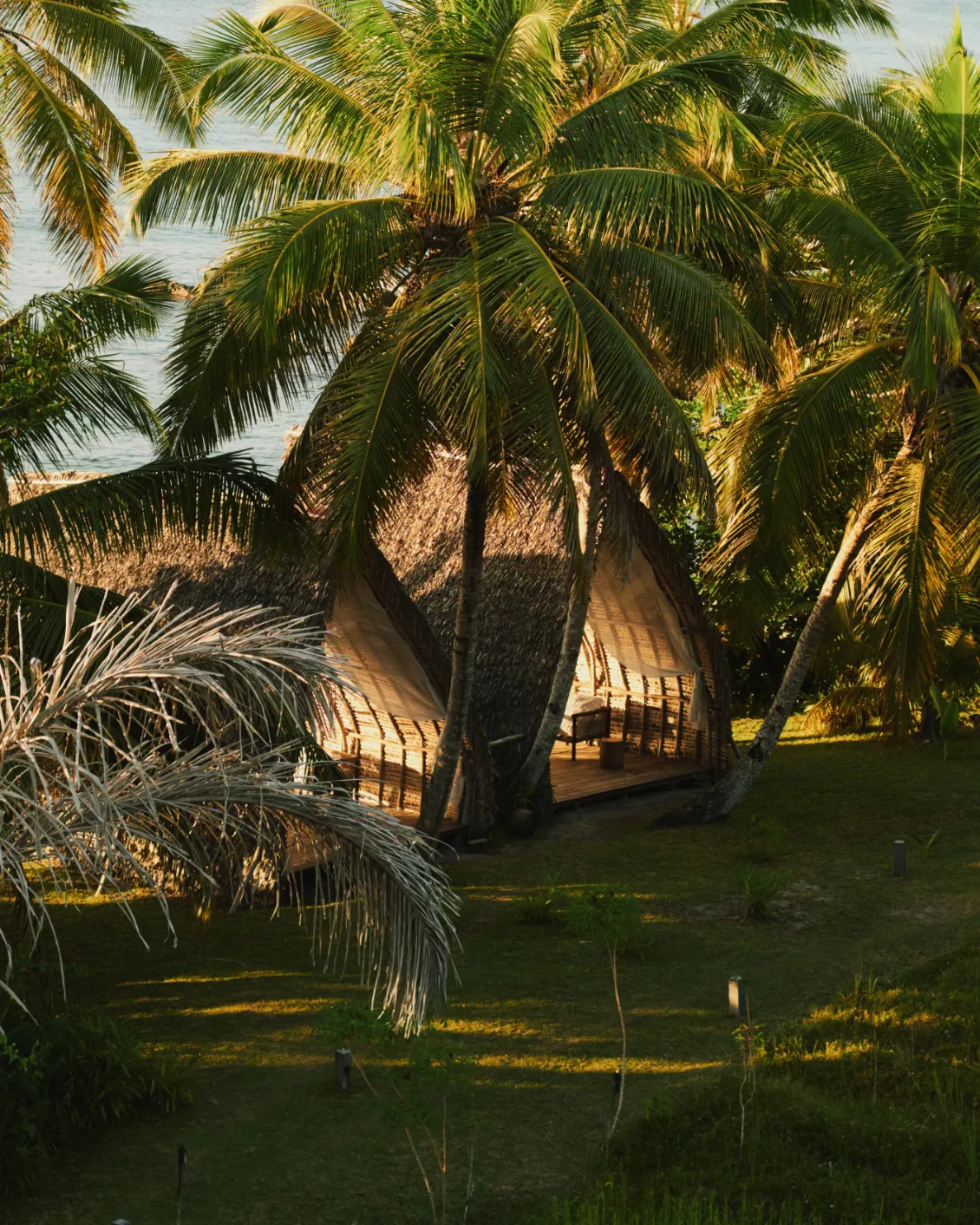
Massages and treatments take place surrounded by nature in the twin spa bungalows
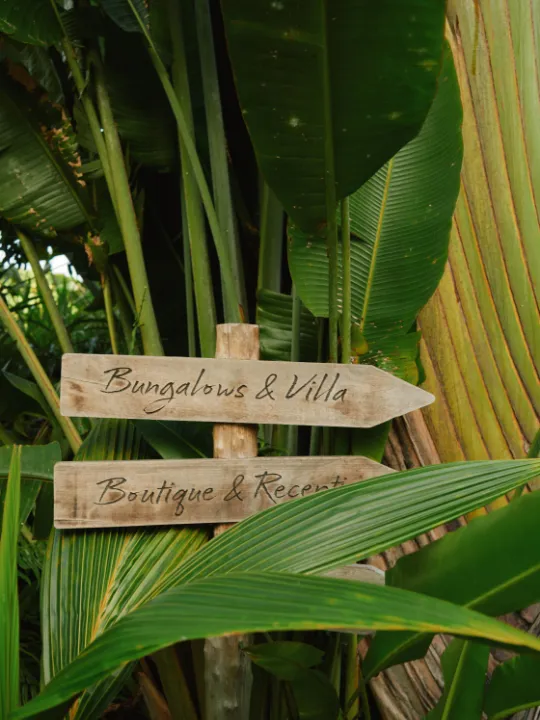
Hand-painted signs show the way
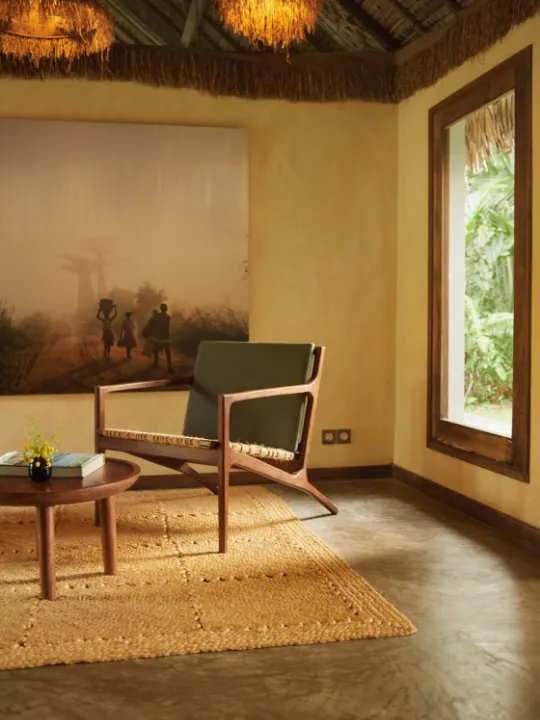
A quiet reading nook inside the three-bedroom villa at Voaara Madagascar
At the heart of Voaara’s social life are its restaurants, where food is central to the experience. Much of what arrives on the plate is grown on-site, sourced from the hotel’s thriving permaculture garden, perfectly suited to the island’s tropical climate. At La Plage by Sarrion, Spanish executive chef Aleixandre Sarrion presents Spanish Mediterranean cuisine layered with Asian and South American influences, all infused with local flavors—sometimes in surprising ways. Vanilla appears not only in desserts but also in savory dishes. Zebu cow tartare, with vanilla beurre blanc, green peppercorn prawns, and vanilla pannacotta with pineapple carpaccio are all dishes to be enjoyed barefoot in the sand and under the open sky. Sushi is prepared using the day’s catch, hauled in from the waters just offshore and served at the Bird’s Nest, a wooden deck that provides a 360-degree view and a telescope, the perfect place to watch the sunset and stargaze late into the night.

Fish tiradito with gazpacho and Jamón Ibérico, served at La Plage by Sarrion

Ravenala, or the traveler’s palm, a striking tropical plant native to Madagascar
But social life extends beyond the hotel’s walls. The resort is deeply rooted in its community and committed to preserving Sainte-Marie’s culture and wildlife. Kjellgren founded Voaara Vahiny, a nonprofit created to ensure that a portion of the hotel’s profits is directed toward reforestation projects and the reintroduction of native species. In July, a school is set to open in the village with the aim to teach local residents sustainable agricultural practices that respect the land and to educate on reef protection. With that, Kjellgren hopes to help protect the oceans and foster richer, more abundant marine life on the island for generations to come.
Nicknamed the “Garden Island,” Sainte-Marie, or Nosy Boraha in Malagasy, is home to hundreds of plant species and a wealth of rare wildlife, nearly 90 percent of which is endemic to Madagascar. Chameleons and vibrant birdlife thrive here, as does the Nosy Boraha mouse lemur—a species that exists nowhere else on Earth but on this 3-by-30-mile isle.

Water lily leaves drift across the lake on the hotel’s property

A female panther chameleon, one of Madagascar’s most iconic endemic species
Each year, from July to September, humpback whales migrate from Antarctica to the warm waters surrounding Sainte-Marie to mate, give birth, and teach their calves to breach. Boat excursions over extraordinary encounters, as whales slap their fins and tails against the water and swim astonishingly close. Local tradition dictates one important taboo, known as a fady: Pointing at a whale is considered disrespectful. Instead, observers are welcomed to gesture to the majestic creatures with a closed fist, and enjoy the spectacle with a wide-open gaze.
With Voaara Madagascar, Philippe Kjellgren is shaping a new vision of conscious luxury, one that aligns with a shifting hospitality landscape and a growing desire for authenticity and presence. It is a destination that offers impeccable comfort, a strong sense of place, and an experience that cannot be replicated anywhere else in the world.

The hotel’s private beach, a secluded stretch of sand reserved exclusively for guests

Up until the French conquest in the 19th century, village life on Madagascar was governed by tangalamena, the authority figures responsible for maintaining order. They were the guardians of fady: the laws or taboos that regulate community life.
A small number of village elders on Sainte-Marie still carry this responsibility, inheriting their role through family lineage, and they ensure ancestral traditions endure and perform rituals to bless actions and protect against misfortune.
In the village near Voaara, there are four tangalamena, aged roughly between 55 and 75. They are called upon whenever a villager seeks a blessing—from wanting to start a new business to trying to conceive. In keeping with tradition, Philippe Kjellgren, co-founder of Voaara Madagascar, asked a tangalamena to bless the land and his project before construction of the hotel began. The ceremony involved the sacrifice of zebus, which are humped cattle native to South Asia and a national emblem of Madagascar.


A street scene in Antananarivo, Madagascar’s capital




 Profile
 Bookings
 Benefits
 Bookmarks
 Exclusive Community Deal